Sustainable development
Increasing added value in the processing of biological natural resources using bioeconomy as a new source of economic growth.
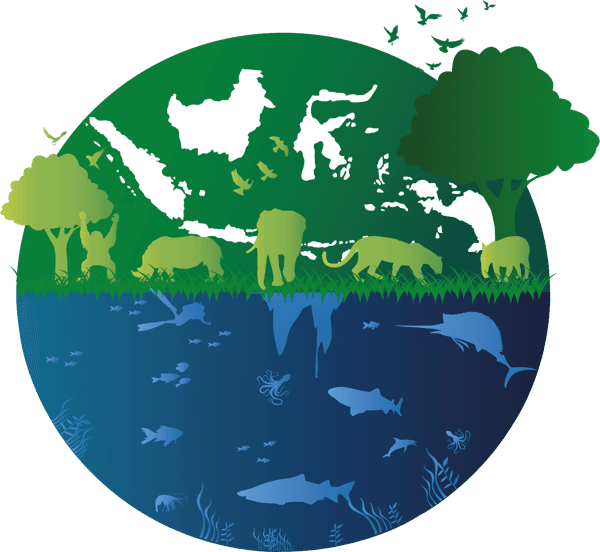 INDONESIA
About Us
Indonesia’s bioeconomy development must not only consider the trajectory of global development, but also align with Indonesia’s national development direction to serve as a driver for achieving the Indonesia Emas 2045 Vision. Based on a curation of existing global definitions, principles agreed upon within the G20 forum, and the policy direction of the 2045 RPJPN, the definition of Indonesia’s bioeconomy is proposed as follows:
“Bioeconomy is an economic model that utilizes biological resources and processes in a sustainable manner to create higher value-added goods and services for Indonesia, thereby advancing the nation as a just, prosperous, and sustainable economy while upholding the essence of humanity.”
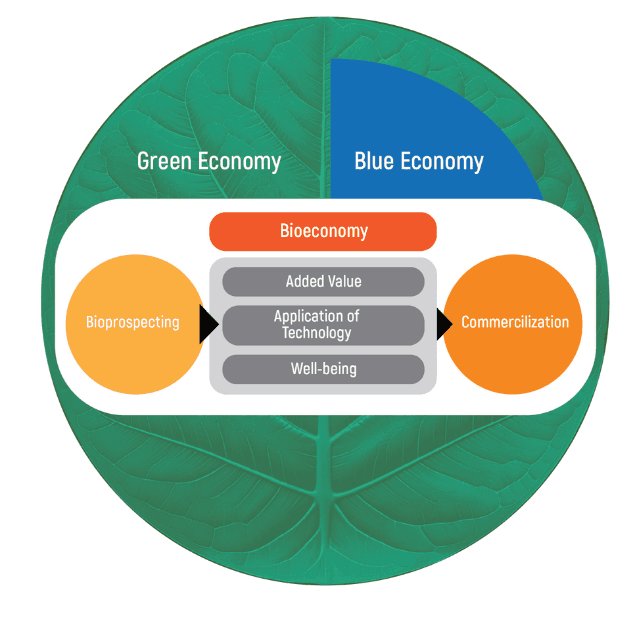
The definition of bioeconomy is expected to serve as an umbrella concept for various stakeholders so that its implementation can collectively lead toward the same national objectives. In general, three key elements are reflected in the formulation of the definition of bioeconomy above, namely:
Refers to the utilization of plants, animals, and microorganisms processed using specific technologies while safeguarding environmental sustainability, thereby ensuring that economic activities remain sustainable.
Refers to biological resources that have been processed to yield products with significantly greater economic value. This also drives innovation to produce efficient products and minimize excessive resource consumption while maximizing economic benefits.

Refers to economic value that is generated by prioritizing social justice and natural resources sustainability. This criterion also serves to limit economic activities that degrade the quality of human life and to prevent social disparities, in alignment with the mandates set forth in the Preamble of the 1945 Constitution.
Our Values
As an economic approach, the utilization of biological resources must generate a higher value-added compared to conventional practices — through innovation, quality enhancement, or efficiency by applying circular economy principles — accompanied by fair benefit-sharing across the entire value chain, preventing the exploitation of any single stakeholder.

The deployment of technology or biotechnology provides a key point of differentiation from extractive-based natural resource economic models — including software, artificial intelligence, robotics, and automation, or even the utilization of living organisms — together with appreciation and recognition of local wisdom: legal certainty over land sustainably managed by traditional communities and fair benefit-sharing derived from the utilization of intellectual property (IP) rights associated with traditional know-how.

This criterion aims to drive bioeconomy activities that elevate the quality of life, while restricting development that could be harmful, such as weaponry. Economic welfare can be measured through rising community incomes; social well-being is measured by the active engagement and empowerment of communities.
Our Principles
Open each principle to see its relevance to national policy documents.
Increasing added value in the processing of biological natural resources using bioeconomy as a new source of economic growth.
Creation of mid-to-high-level employment opportunities in productive sectors, including green and blue jobs.
Transforming food systems toward sustainable, healthy, and resilient food system eco-regions based on local resources and local wisdom.
Thousands of Indigenous Peoples and local communities in Indonesia inhabit various regions rich in biodiversity and demonstrate high commitment to environmental sustainability. Agroforestry approach involves local communities.
Strengthening gender mainstreaming and social inclusion to ensure no one is left behind in development.
Climate-resilient development to minimize potential economic losses resulting from climate change.
Genetic, species, and ecosystem diversity.
The utilization of biological resources as high value-added products, specifically pharmaceuticals, food, feed, materials, and energy to reduce reliance on fossil resources.
The engagement and provision of financial and/or non-financial benefits for Indigenous Peoples and/or traditional communities as custodians of biological resources, including genetic resources, which serve as the source of livelihood for the community.
Strengthening the sustainable research and innovation ecosystem, including regulatory frameworks, financing and investment, and research personnel for bioeconomy development.
Macroeconomic stability is maintained, supported by increasingly robust synergy between fiscal and monetary policies in addressing various global and domestic pressures.
This strategy aims to drive economic growth while fostering social well-being and preserving environmental quality.
The state must undertake various efforts to fulfill citizens’ rights to work and a livelihood that is humane through job creation.
Indicators from the Green Economy Index.
Enhancing North–South, South–South, and triangular cooperation at regional and international levels, as well as access to science, technology, and innovation, and improving knowledge-sharing based on mutual agreement, including through enhanced coordination among existing mechanisms, particularly at the United Nations (UN) level and via global technology facilitation mechanisms.
Enshrined in Law No. 59 of 2024 concerning the 2025–2045 RPJPN.
Why bioeconomy?
Question 01
Indonesia is one of the world’s mega-biodiversity countries, possessing exceptionally high terrestrial and marine biological resources that can drive inclusive and sustainable economic growth — yet the vast majority of this potential remains largely unexplored and underutilized.
Bioeconomy has been established as a strategic policy mandated within the 2025–2045 RPJPN and the 2025–2029 RPJMN — a key economic transformation agenda supporting the achievement of the Indonesia Emas 2045 Vision.
Every 10% increase in the demand for bio-based products can drive the growth of economic output by up to 9%.
Food, energy, and water self-sufficiency; environmental preservation; and downstreaming and industrialization of natural resources to enhance domestic added value.
The 2030 Sustainable Development Goals (SDGs) Agenda, the Convention on Biological Diversity (CBD) and the Kunming-Montreal Global Biodiversity Framework (KM-GBF); and the G20 Initiative on Bioeconomy (GIB) at the 2024 G20 Brazil summit.
Question 02
Without a shift, biological wealth stays under-used, practice remains scattered across sectors, and the economic and environmental gains modelled for 2045 are left on the table.
IBI scenario compared with business-as-usual, 2045. Modelled scenarios, not measured outcomes.
Bioeconomy practices are implemented in fragmented ways across various sectors, such as forestry, agriculture, and fisheries, without a clear, integrated framework — limiting collective understanding and weakening synergy among related sectors.
Abundant natural resources remain underutilized due to the absence of a clear policy framework and practical guidelines that can be adopted by all stakeholders.
Question 03
The interconnection between bioeconomy and green economy focuses on the sustainable use of biological resources — such as biofuel production from crops, which simultaneously reduces carbon emissions — and the interconnection between bioeconomy and blue economy involves the sustainable use of marine resources, such as ecosystem-based aquaculture. Understanding these interconnections centers on three key aspects: synergy, innovation, and decision-making.
Shares the aim of closing loops; the bioeconomy adds the sustainable valorisation of biomass residues and by-products.
Digital tools — software, artificial intelligence, automation and product traceability — are part of the technology the bioeconomy applies along its value chains.
Named with the green and blue economy in Asta Cita 2; design, branding and local knowledge help bio-based products such as natural cosmetics and local food reach markets.
Natural, human and financial capital, policy and the role of communities — compared across the bioeconomy, circular, green and restorative economy below.
A study conducted by Cendekia Iklim Indonesia, based on a systematic literature review and policy document analysis, examined 147 documents retrieved from the Scopus database, 87 of which were selected through the PRISMA process.
| Dimension | Bioeconomy | Circular Economy | Green Economy | Restorative Economy |
|---|---|---|---|---|
| Natural capital | Management of biomass (bioresources) stock and quality, and sustainable valorization of residues and by-products. | Natural capital maintenance and regeneration by closing the loop (reuse, recycle, remanufacturing, reduction of waste). | Natural capital investment and protection with safeguards as the basis of green growth. | Rehabilitation and restoration of damaged ecosystems through active restoration. |
| Human capital | Technical and social skills across the biomass value chain (farmers, fishers, technicians, scientists, local communities). | Organizational capacity building and knowledge development to support the adoption of circular models. | Improvement of public knowledge and awareness of sustainability. | Technical and social expertise for long-term restoration and stewardship. |
| Financial capital | Investment and business viability across bio-based value chains (production, processing, and biotechnology). | Capital as a driver of innovation and circular business models. | Green incentives and financing to steer the economy. | Financing for restoration projects and the transition to restored ecosystems. |
| Policy & regulation | Cross-sectoral policy frameworks for the management of biomass, bioindustry, ethics, and research and development (R&D). | Regulations that promote circularity, including extended producer responsibility (EPR), design standards, and incentives for circular businesses. | General green policies covering environmental standards, emissions, and nature conservation. | Policies that ensure ecological restoration and long-term tenure security. |
| Community role | Communities as producers, industry partners, and ecosystem stewards within bioeconomy value chains. | Stakeholder involvement in value creation within circular business models, with communities often positioned as users or markets. | Participation in green programs and policies, which are often top-down in nature. | Communities are central actors in socio-ecological restoration projects. |
Question 04
The development of Indonesia’s bioeconomy remains in its early stages. Four governance gaps stand between potential and practice.
Several overarching policies relevant to the bioeconomy exist, but they remain heavily divided across sectoral silos; greater policy alignment is imperative to foster cross-sectoral synergy.
A robust ecosystem among the government, investors, industry, and market actors remains underdeveloped, underscoring the need for an integrated policy framework spanning from upstream production to downstream commercialization.
Indonesia currently faces a shortage of commercially viable business models, resulting in limited corporate investment appetite due to high risks and costs.
Investments in R&D remain insufficient and tend to be concentrated within isolated business units, thus limiting Indonesia’s capacity to optimize the full scope of its bioeconomy potential.
Question 05
The advancement of bioeconomy in Indonesia represents not only an economic transformation, but a social transformation as well. Each actor has a role along the value chain.

Community-based producers sustain local bioeconomies through the responsible use of biological resources, biodiversity-friendly production, and the creation of local economic value.

Communities contribute to bio-based industries as suppliers and service providers, while sustainable sourcing and fair partnerships help maintain resource availability and ensure inclusive value creation.
Indigenous Peoples and local communities contribute to conserving ecosystems and biodiversity, helping sustain the biological resources and ecological functions on which long-term bioeconomy development depends.
Regulations, incentives for bioeconomy industries and policy synergy across sectors, accounting for the proportional role of business actors alongside the government.
Commercially viable business models, investment in processing and R&D, and fair partnerships with producers.
Basic and applied research in biotechnology, integrated into industrial sectors to enable practical applications in product and technology development.
Ecosystem partners support the initiative.